International E-Waste Day 2025
October 14, 2025
Half of consumers in Ireland don’t realise the materials in their old electrical and electronic appliances contain critical raw materials essential for the manufacture of new technology and renewable energy sources.
The data by Waste Electrical and Electronic Equipment (WEEE) Ireland shows that while 8 in 10 of adults say they recycle their e-waste to help the environment, only 5 in 10 recognise that it is essential that we in Europe recover the critical raw materials inside old devices.
That figure rises to 6 in 10 among 18-24-year-olds, the highest of any age group, indicating that while younger generations care deeply about environmental issues, they may not connect recycling with resource recovery and the development on new renewable energy, digital and defence technologies.
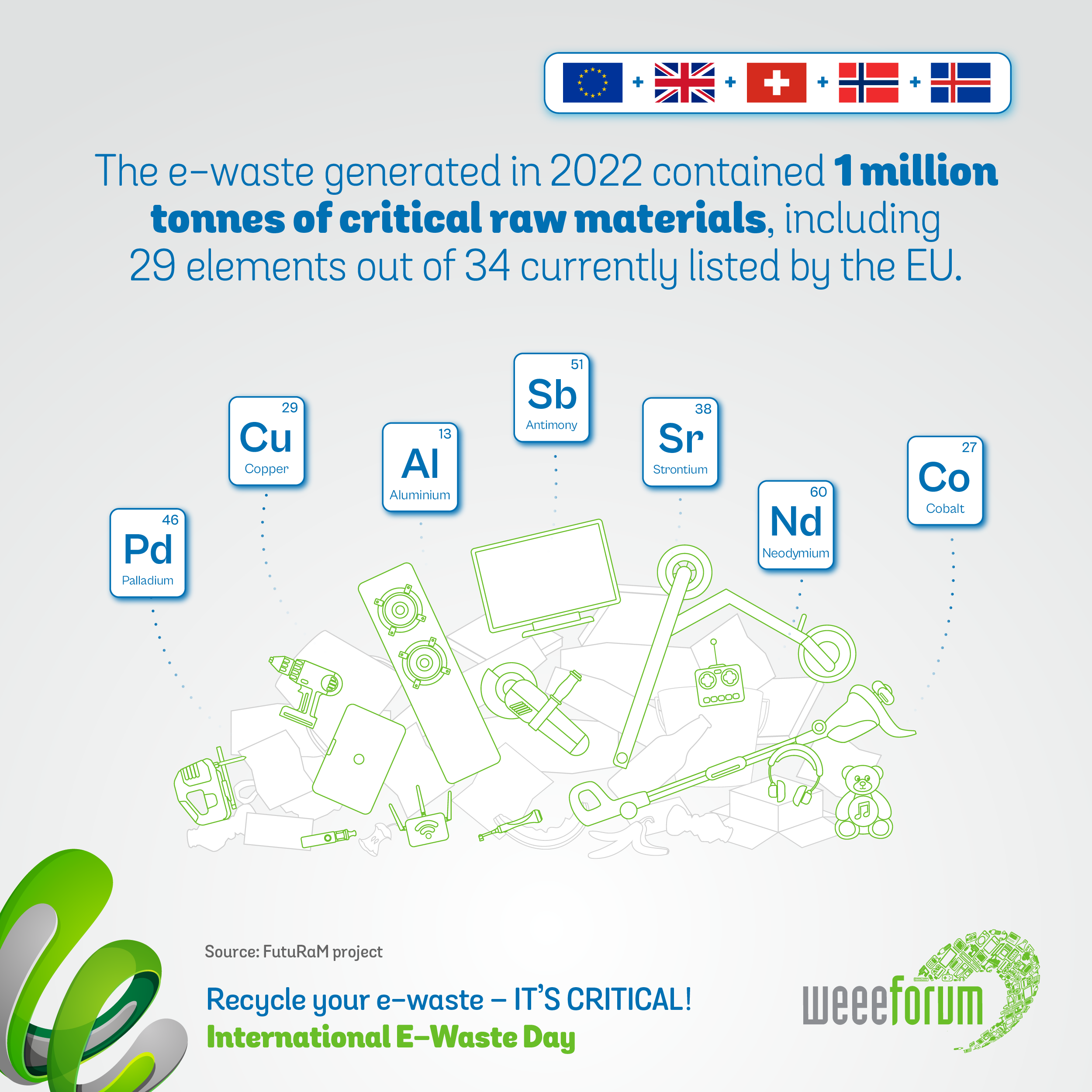
Not-for-profit organisation WEEE Ireland says it is a major blind spot that could be costing Ireland valuable critical raw materials needed for a greener future.It released the data to coincide with today’s (Oct 14) International E-Waste Day, with European statistics warning that the continent’s e-waste mountain now hides one million tonnes of critical raw materials (CRMs) every year, including aluminium, copper, lithium and nickel.
“Most Irish adults recycle their old electronics because they care about the planet – but few realise just how important it is for us to recover the critical raw materials form those discarded devices ,” said Leo Donovan, CEO of WEEE Ireland.
“Every old and broken phone, hairdryer or game controller tucked away at home contains critical raw materials that the EU desperately needs to be less reliant on China.
“Europe’s e-waste is now being called the new oil, and Ireland’s contribution to that well of resources can either sit gathering dust or be mined responsibly for a circular future.
“We’re urging everyone – if it’s old, broken or now obsolete recycle it.”
WEEE Ireland’s research, conducted by Empathy, also found that almost 1 in 3 people keep unused tech as a “back-up”, leaving a hidden hoard of critical raw materials gathering dust in homes across Ireland.
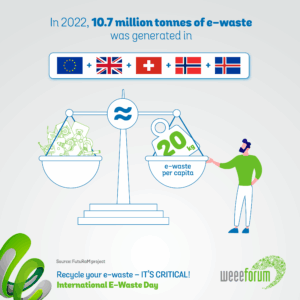
In a European context, a report prepared by the Futuram (Future Availability of Secondary Raw Materials) consortium for International E-Waste Day 2025, shows that e-waste across Europe, in addition to the UK, Iceland, Norway and Switzerland, now contains enough embedded critical raw materials to fill 50,000 shipping containers, weighing around one million tonnes.
These materials are essential for heat pumps, wind turbines, EV chargers, servers, smartphones and defence equipment.
By 2050, Europe’s e-waste could rise to as much as 19 million tonnes annually, containing 1.9million tonnes of critical raw materials, making collection and recycling more urgent than ever.
The findings feed directly into Europe’s evolving policy framework which includes most notably the Critical Raw Materials Act (2024) which sets benchmarks for extraction, processing, and recycling of strategic materials, aiming for 25% of annual demand to be met from recycling by 2030.
Currently, just 1% of critical raw material requirements are met by e-waste recycling.
In addition the forthcoming WEEE Directive Revision 2026 is expected to tighten collection and reporting rules, boosting demand of secondary raw materials and traceability. Furthermore the ongoing Circular Economy Act consultation is examining current barriers in the EU market such as the lack of sufficient demand and supply of secondary raw materials and the fragmentation of the single market
“With Irish consumers currently only recycling 3 end-of-life electrical items for every 10 new purchased, the potential impact of recycling is immense,” said Mr Donovan
“A concerted effort to collect and recover could extract hundreds of tonnes of reusable metals from obsolete gadgets and appliances.”
WEEE Ireland is urging people to drop off old and broken electronic devices, batteries, and cables for free recycling at one of the hundreds of local authority civic amenity centres and participating electrical retailers.